The Real Cost of Acquiring a Client: Why Cost Per Click Is Misleading
Lead Systems Go and Financial Aivisor are a marketing company. We are not attorneys, compliance consultants, investment advisers or broker-dealers, and nothing here is legal, compliance or investment advice. Rules change and their application depends on your firm's structure and registration. Always confirm with your firm's compliance officer or securities counsel before running any campaign.
Every week, a financial advisor somewhere fires their marketing agency because "the cost per click is too high." They found a cheaper agency that promises $3 clicks instead of $15. Three months later, they have a spreadsheet full of cheap clicks and zero new clients.
This happens constantly because the financial advisory industry is obsessed with the wrong metric. Cost per click tells you how much it costs to get someone to your landing page. It tells you almost nothing about how much it costs to put a qualified prospect in your office, which is the number that actually matters.
Let's fix that.
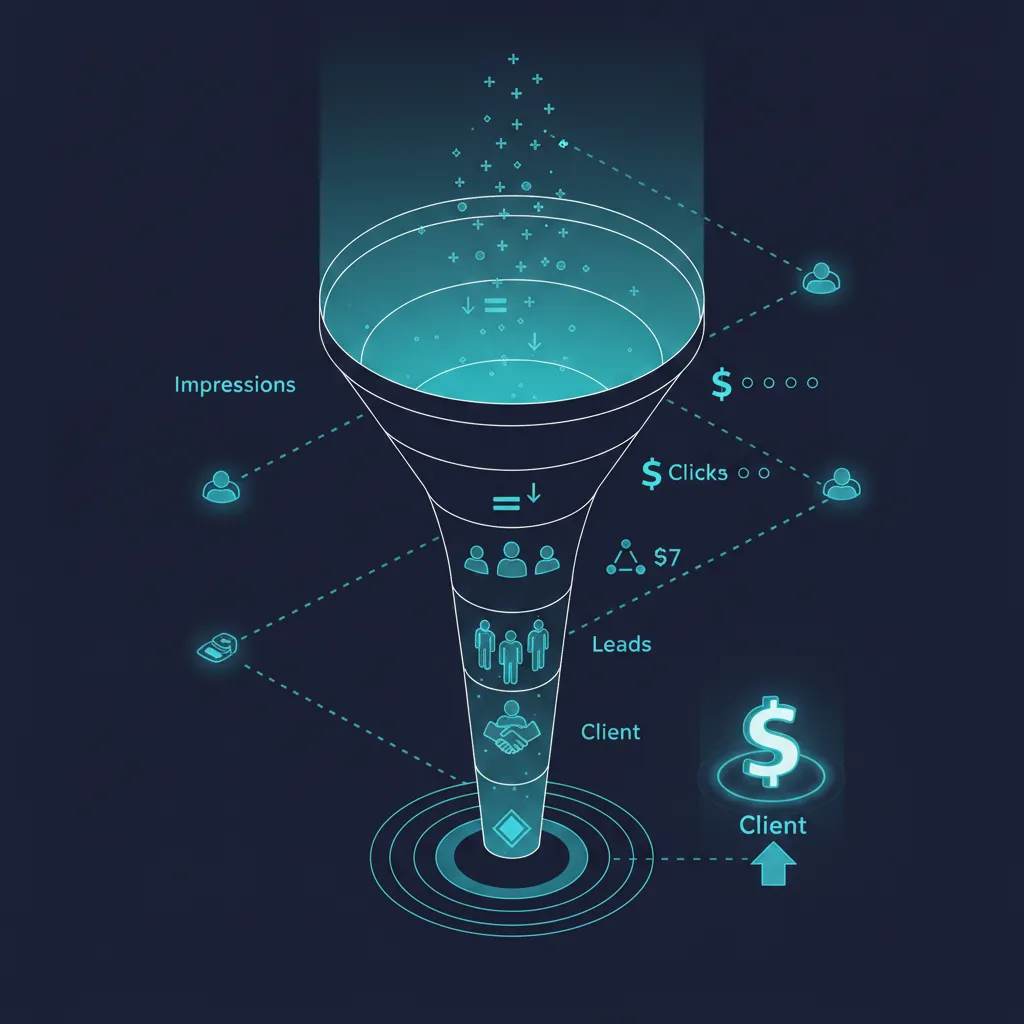
The Full Funnel: From Impression to Client
Every new client starts as a stranger who saw your ad. Between that first impression and a signed advisory agreement there are five stages. Each one costs money, and each one loses people. We are deliberately not printing example figures here, because the moment you read ours you will anchor on them instead of finding yours. Open your ad account and your CRM and fill in the blanks:
- Impressions. What you paid to put your ad in front of people. Moved by how competitive your market is, how tightly you have defined the audience, and how much of your budget the platform can spend before it runs out of people who match.
- Clicks. What share of the people who saw it cared enough to tap. Moved by the offer, the headline and whether the ad speaks to a problem the viewer already knows they have. A low rate here usually means the message is wrong or the audience is.
- Leads. What share of visitors gave you their name. Moved by the landing page: whether it answers the question the ad raised, how much it asks for, and how long the form is. This is the stage most advisors can improve fastest and cheapest.
- Booked and kept appointments. What share of leads ended up sitting across from you. Moved almost entirely by follow-up speed and persistence, and by whether the confirmation and reminder sequence exists at all. Count kept appointments, not booked ones; no-shows cost you the same money and none of the revenue.
- Signed clients. What share of those meetings became relationships. Moved by fit, by your consultation itself, and by whether the people arriving were ever plausible clients to begin with.
Divide your total spend for a period by the number of clients at the bottom, and that last number, what it costs you to acquire one client, is the figure that should drive your marketing decisions. Everything above it is a waypoint, useful for diagnosing where you are losing people but not for judging whether the spend was worth it. Work the list from the bottom up. A funnel that leaks between lead and kept appointment cannot be fixed by buying cheaper clicks, and most of them leak exactly there.
The Cheap Click Trap
Picture two advisors with the same monthly budget and two different definitions of success.
Advisor A judges the agency on cost per click, so the agency delivers cheap clicks. The reliable way to make clicks cheap is to widen the audience and lower the bid, which means reaching people who are curious rather than people who are in-market. The clicks arrive in volume. The landing page converts poorly, because the traffic was never matched to the offer. The leads that do come in are mostly unqualified, so the calendar fills with consultations that were never going to sign, and the ones who do sign tend to be the smallest relationships in the book. Advisor A reports a great cost per click all year.
Advisor B judges the same budget on cost per acquired client, and accepts expensive clicks to get there. The targeting narrows to people with the assets, the age and the life trigger that make advice urgent: a retirement inside five years, a business sale, an inheritance. Fewer people click. A far higher share of the ones who do fill out the form, because the page is answering a question they actually have. The consultations are with people who were already looking for an advisor, and the relationships that come out of them are larger.
Same money. Two different questions asked of it. The trap is that Advisor A's metric improves while Advisor A's practice does not, and the metric is the one that gets reported in the monthly call. A cheap click that never becomes a client did not save you anything; it spent your budget and returned nothing, which makes it the most expensive kind of click there is. You can settle which advisor you have been by pulling your last four quarters and dividing total spend by clients signed. That single division tells you more than a year of click reports.
The bitterness of poor quality remains long after the sweetness of low price is forgotten. Every advisor who has chased cheap clicks learns that on their own timeline.
The Metric That Changes Everything: Lifetime Client Value
The conversation about client acquisition cost is incomplete without the other half of the equation: what is a client worth?
Work that out from your own book rather than from an industry average. Take a client with $500,000 in investable assets. At a 1% AUM fee, that is $5,000 a year in recurring revenue. Now multiply by how long your clients actually stay, which is a number you can get from your own records rather than from anyone's benchmark. If that client stays ten years, one relationship is worth $50,000 in revenue. At $20,000 a year, it is worth four times that.
Then set an acquisition cost against that. Kitces Research put the average all-in cost of winning one new client at $3,119, a figure worth sitting with and one we come back to in a moment. Measured against it, a relationship worth $50,000 returns roughly 16 to 1, and every dollar you take off the acquisition cost widens that gap. The $50,000 is arithmetic from the worked example above, not a claim about your book. Run it again with your own fee and your own tenure, and the ratio you get is the one that should decide what an acquisition is worth paying for.
Kitces Research put the average all-in cost of acquiring one new client at $3,119, of which $519 was hard-dollar marketing spend and roughly $2,600 was the value of the advisor's own time. Across strategies the range ran from about $338 per client to more than $25,000. Two things in that are worth sitting with. First, most of what a client costs to acquire is not invoiced to you, it is your own hours. Second, the spread between $338 and $25,000 is the whole game. The strategy you pick, and how much of your calendar it eats, matters far more than shaving a few dollars off a click.
Where Most Advisors Lose the Most Money
The biggest cost in your funnel isn't the click, the lead, or even the appointment. It's the drop-off between lead and appointment. Most firms have no idea what their own rate is there. Pull last quarter out of your CRM, count the inquiries, count the consultations that were actually booked, and divide. Whatever share of those leads never booked is the share of your ad budget that bought you nothing.
Why does that gap open? Slow follow-up. Inconsistent follow-up. No follow-up.
A lead comes in at 8pm. You see it at 9am the next day. You call, they don't answer. You leave a voicemail. You send an email. You try again Thursday. By then, they've already booked with the advisor who texted them back in 45 seconds.
This is where AI-powered follow-up through Go Close is designed to compress the funnel. When every lead gets an instant, intelligent response, with qualifying questions, objection handling and calendar booking, more of the leads you have already paid for turn into kept appointments. Every point of improvement there lowers your effective cost per client without adding a dollar to your ad budget, which is why it is usually the cheapest fix available to a practice that is already advertising.
The Metrics Dashboard You Actually Need
Stop looking at cost per click. Here's what should be on your marketing dashboard. Set your own targets in the right-hand column once you have three months of your own data; the numbers below are a starting frame, not a standard:
- Cost per qualified lead: What does it cost to get someone who actually fits your ideal client profile to raise their hand?
- Lead-to-appointment rate: What percentage of leads become booked meetings?
- Cost per kept appointment: Factoring in no-shows, what does each face-to-face meeting cost?
- Appointment-to-client rate: What percentage of consultations become signed clients?
- Cost per acquired client: The real number, and the one to defend.
- Client lifetime value to acquisition cost ratio (LTV:CAC): How many times over does one client repay what it cost to win them?
When you track these, the conversation with your marketing partner changes completely. You stop asking "why are clicks so expensive?" and start asking "how do we get more clients like this one, and what is the most we can afford to pay for them?"
The Compounding Effect of Getting This Right
Here is where the math gets interesting. Run it with your own numbers; ours are placeholders. Assume you invest $5,000 per month in a targeted advertising system with AI follow-up, and that it produces 3 new clients per month, each generating $5,000 per year.
After year one: 36 new clients generating $180,000 in annual recurring revenue on $60,000 in marketing spend.
After year three, if the pace holds: your year-one clients are in their third year, your year-two clients in their second, and the book has grown by $180,000 three times over. That is $540,000 in annual recurring revenue against $180,000 of cumulative marketing spend.
The point is not the specific figures, which will not be yours. It is the shape. Marketing cost stays roughly linear while revenue stacks, because advisory revenue is recurring. A client acquired this month tends to keep paying for years, and a client acquired with cheap clicks who leaves in eighteen months does not.
This is why the more deliberate advisory firms treat client acquisition spending as an investment with a measurable return rather than an expense to be minimized. The advisors watching their cost per click are saving pennies. The advisors watching their lifetime value are building something.
Sources: Kitces Research, Client Acquisition Costs
Frequently Asked Questions
What is the average cost per click for financial advisor ads?
There is no published benchmark for advisor click costs that we are willing to stand behind, and the number swings hard by market, keyword, platform and season. Search clicks in financial services sit at the expensive end of digital advertising and social clicks sit well below them, but your own ad account already holds your real number. The more useful point is that cost per click is a misleading metric on its own. What matters is cost per acquired client, which reflects conversion at every stage of the funnel.
How much does it cost a financial advisor to acquire a new client?
Kitces Research put the average all-in cost of acquiring one new client at $3,119, of which $519 was hard-dollar marketing spend and roughly $2,600 was the value of the advisor's own time. Across strategies the range ran from about $338 per client to more than $25,000. That spread is the real finding. What you pay per client depends far more on which strategy you run, and on how much of your own time it consumes, than on any single industry average.
What is the lifetime value of a financial advisory client?
Work it out from your own book rather than an industry average. Take your average annual revenue per client and multiply it by how long your clients actually stay. A client paying $5,000 a year who stays ten years is worth $50,000 in revenue, and a client paying $20,000 a year is worth four times that. Both inputs are sitting in your own records, and they are the only ones that should drive a marketing decision.
Why is cost per click a bad metric for financial advisor marketing?
Cost per click only measures the first step of a multi-stage funnel. A cheap click that never converts to a lead, appointment, or client is worthless. Conversely, an expensive click from a highly qualified prospect who becomes a long-term client is extremely valuable. The metrics that matter are cost per qualified lead, cost per appointment, and cost per acquired client.
What marketing ROI should financial advisors expect from digital advertising?
We will not quote you a number, because return on ad spend depends on your fee schedule, your close rate and how long clients stay. Do the arithmetic with your own figures instead. Divide what you spent last quarter by the clients it produced, then set that against what one client pays you over the life of the relationship. Advisory revenue is recurring, which is why acquisition spending is better judged over the lifetime of a relationship than inside a single month.
Know Your Real Numbers
We'll walk through your funnel economics and show you exactly what it costs to acquire a client with Go Grow and Go Close.
Book a Free Strategy Session